Overview
A chess engine is a program that plays chess. It has two halves: a search that looks ahead through possible moves and replies, and an evaluation that judges how good each resulting position is. NARC Genesys is the latest major release of the NARC project, a complete re-implementation of the original NARC engine, built to be as efficient and strong as possible.
It was developed as an individual project using AI-accelerated research and development. Large language models were used as tools to speed up the work, while every key technical and strategic decision behind the engine's strength was made independently. That combination made it possible to test hundreds of ideas in about three months.
Every idea, tested properly
Each change was measured with SPRT matches, a statistical method that plays games until it's clear whether a change really helps. Most ideas were rejected. The biggest gains came from two places: choosing high-quality training data and optimising the design of the neural network.
An engine that learned from itself
NARC Genesys started with a hand-written evaluation and then improved itself in cycles. Its first neural network (NNUE) was trained on just one million positions from its own games, and it beat the hand-written version by roughly 100 Elo. The process was then repeated, with the dataset growing each time and a stronger version of the engine re-scoring every position.
The final network was trained on a carefully filtered mix of the engine's own games, high-quality positions from the open Lichess database and openly licensed self-play collections. Every position was scored by NARC's own engines, so no other engine's knowledge was copied into it.
The networks of most 3500+ engines are trained on billions of positions. NARC Genesys was trained on about 249 million — and competes with them.
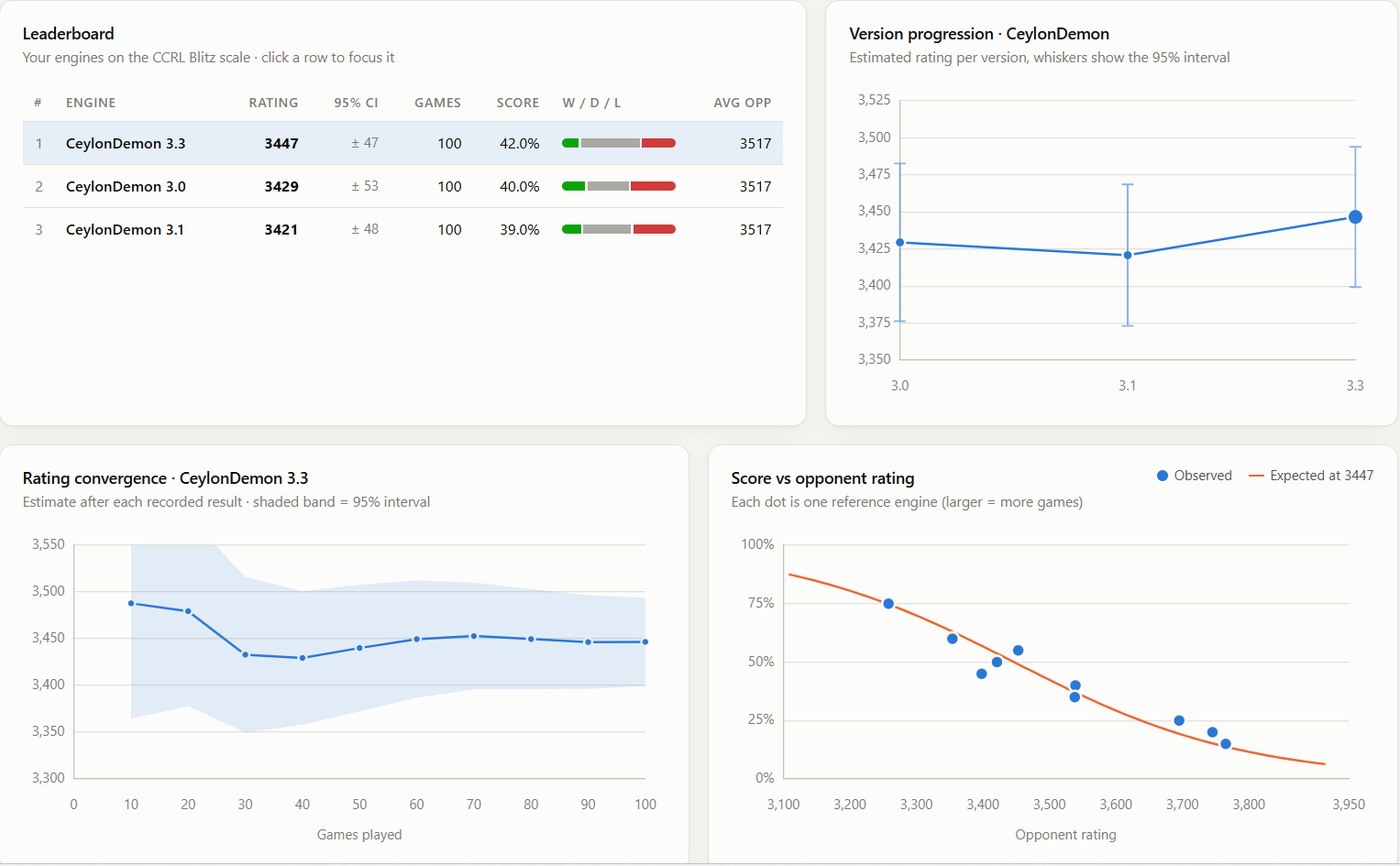
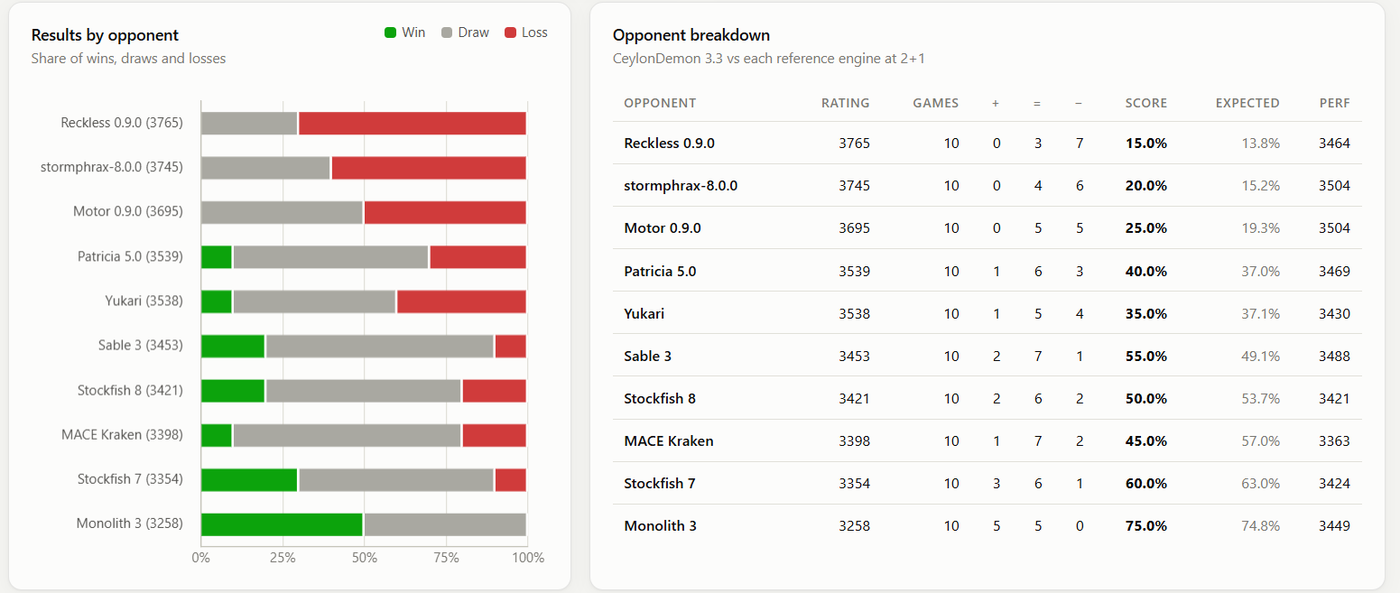
Its estimated strength of about 3608 on the CCRL Blitz scale comes from a gauntlet of 1,980 games against nine CCRL-rated engines. The engine hasn't hit a strength ceiling; progress is currently limited by available computing power.
What's new in 5.1
- A wider neural network with 1,024 neurons per side instead of 256, trained from scratch on the same 249 million positions. It judges positions more accurately, at the cost of running 25–40% slower.
- ThreatHist, a smarter way of ordering moves that considers whether a piece's starting and landing squares are under attack, so better moves are tried first. On its own it gained +13.2 Elo.
- Overall, 5.1 measured +29.9 Elo stronger than 5.0 over 756 games.
Version history
| Version | Approx. CCRL Blitz | Official CCRL 40/15 |
|---|---|---|
| NARC Engine | 2950 | — |
| NARC NEXT 4.1 | 3400 | 3320 (rank #168) |
| NARC Atlas 4.5 | 3500 | Private |
| NARC Genesys 5.0 | 3600 | Pending |
| NARC Genesys 5.1 | 3608 | Pending |
Under the hood
NARC Genesys is an original engine — not a fork or clone, and containing no code copied from other engines. Like nearly every modern engine, it uses well-known published techniques, written in its own code: alpha-beta search with aspiration windows, late move reductions, null-move and futility pruning, singular extensions, history-based move ordering, multi-threaded Lazy SMP search, magic bitboards, and an NNUE evaluation with king and material buckets stored in its own network format. Two components follow Stockfish's published design and are credited openly.
Carefully chosen data beat datasets many times larger.
Every change proved with statistics before it was kept.